


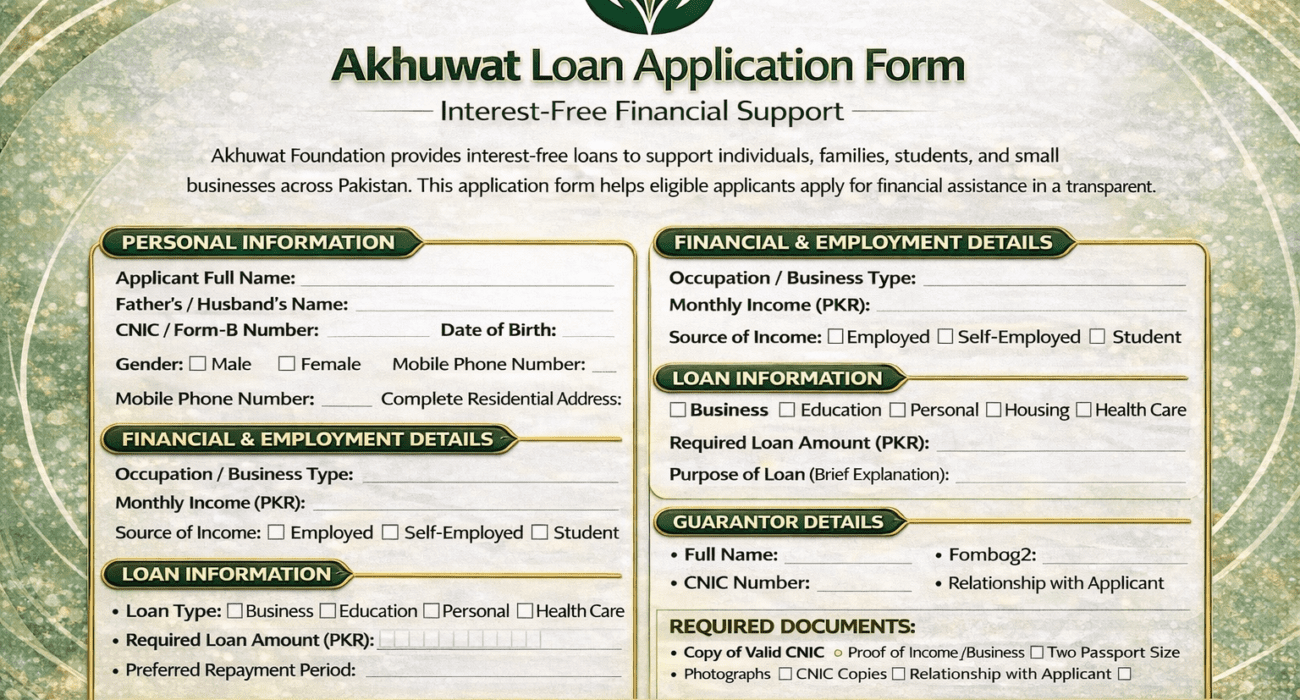
Understanding akhuwat loan types is essential for applicants seeking interest free financial support in Pakistan. Managed by Akhuwat Foundation, this system operates under Qarz e Hasna, offering ethical financing without interest, collateral, or hidden charges. The structure focuses on need based lending rather than profit.
This guide explains all major akhuwat loan types, their eligibility, loan limits, and the akhuwat maximum loan amount available across categories. Readers looking for accurate and practical clarity will find this content aligned with official practices. For deeper understanding consult the internal resource on akhuwat loan types available on this website.
Overview of Akhuwat Loan System
The akhuwat loan system is designed to support low income individuals through interest free loans aimed at economic stability and self reliance. Unlike commercial banks the focus remains on social welfare, community trust, and repayment responsibility.
Each loan category under akhuwat loan types follows a standardized evaluation process involving social appraisal, community verification, and repayment capacity assessment.
Major Akhuwat Loan Types Explained
The akhuwat loan types are structured to address diverse social and economic needs. Each category has defined limits and purpose.
Akhuwat Business Loan
The akhuwat business loan supports microenterprises, vendors, and small traders. This category enables income generation and sustainable livelihoods.
Typical loan limits range from PKR 10,000 to PKR 500,000 depending on business scale, experience, and repayment capacity.
Akhuwat Education Loan
The akhuwat education loan supports students by covering tuition fees, books, and academic expenses. The focus is on continuity of education.
Loan limits usually range between PKR 20,000 and PKR 100,000, subject to institution level and family income assessment.
Akhuwat Housing Loan
Under akhuwat loan types, the housing loan assists families with house construction, repairs, or improvements. This category promotes safe shelter and social stability.
Loan amounts generally range from PKR 50,000 to PKR 500,000, finalized after on site verification.
Akhuwat Marriage Loan
The akhuwat marriage loan supports families facing financial difficulty during marriage arrangements. The goal is dignity without debt pressure.
Typical loan limits are up to PKR 50,000, depending on household income and repayment ability.
Akhuwat Health Emergency Loan
This category addresses medical emergencies where immediate financial support is required. It ensures timely treatment without financial exploitation.
Loan limits usually remain lower, often up to PKR 25,000, based on urgency and assessment.
Akhuwat Transport and Vehicle Loans
Under evolving akhuwat loan types, transport related loans support mobility for livelihood, including rickshaws and basic vehicles.
Loan limits vary by purpose and typically range from PKR 100,000 to PKR 500,000.
Akhuwat Maximum Loan Amount Explained
The akhuwat maximum loan amount depends on the loan category, repayment history, and economic assessment. There is no single fixed cap applicable to all applicants.
In practice the akhuwat maximum loan can reach up to PKR 500,000 for housing and business loans, subject to strict evaluation and approval committee review.
Eligibility Criteria Across Akhuwat Loan Types
Eligibility for akhuwat loan types is assessed through social rather than conventional credit scoring methods.
Applicants must
• Be Pakistani citizens
• Hold a valid CNIC
• Belong to a low income household
• Demonstrate genuine need
• Provide community based guarantors
• Show repayment capability
Eligibility conditions vary depending on the selected akhuwat loan type.
Documents Required for Akhuwat Loans
Accurate documentation is mandatory across all akhuwat loan types to ensure transparency and accountability.
Required documents include
• CNIC copies of applicant and guarantors
• Recent photographs
• Utility bill for address verification
• Purpose specific documents
• Guarantor CNIC copies
Complete documentation improves approval efficiency and reduces delays.
How Loan Limits Are Determined
Loan limits under akhuwat loan types are determined through field assessment, income analysis, and community verification. The goal is sustainability rather than over financing.
This approach ensures that the akhuwat maximum loan remains affordable and repayable without financial stress.
Repayment Structure Across Loan Categories
All akhuwat loan types follow a standardized interest free repayment model designed to be respectful and manageable.
Key repayment features include
• Zero interest installments
• Fixed monthly payments
• Flexible repayment duration
• Strong community accountability
Timely repayment supports the continuity of interest free financing.
Is Akhuwat Loan System Trustworthy
The akhuwat foundation loan system is legally registered, nationally respected, and governed by ethical oversight. It has served millions of beneficiaries across Pakistan.
Transparency, community involvement, and high repayment rates establish strong trust in akhuwat loan types.
Important Guidance for Applicants
Applicants should carefully evaluate loan purpose, eligibility, and repayment responsibility before selecting among akhuwat loan types. Accurate disclosure strengthens approval prospects.
For official updates and verified guidance applicants should consult the internal resource on akhuwat loan types available on this website.
Conclusion
The akhuwat loan types framework offers a comprehensive range of interest free financial solutions tailored to diverse social and economic needs. With clearly defined limits, ethical evaluation, and community based accountability, the system ensures dignity without exploitation.
Applicants who understand the akhuwat maximum loan, choose the appropriate category, and commit to responsible repayment can confidently rely on akhuwat loan types as a trusted and sustainable financial support system in Pakistan.